


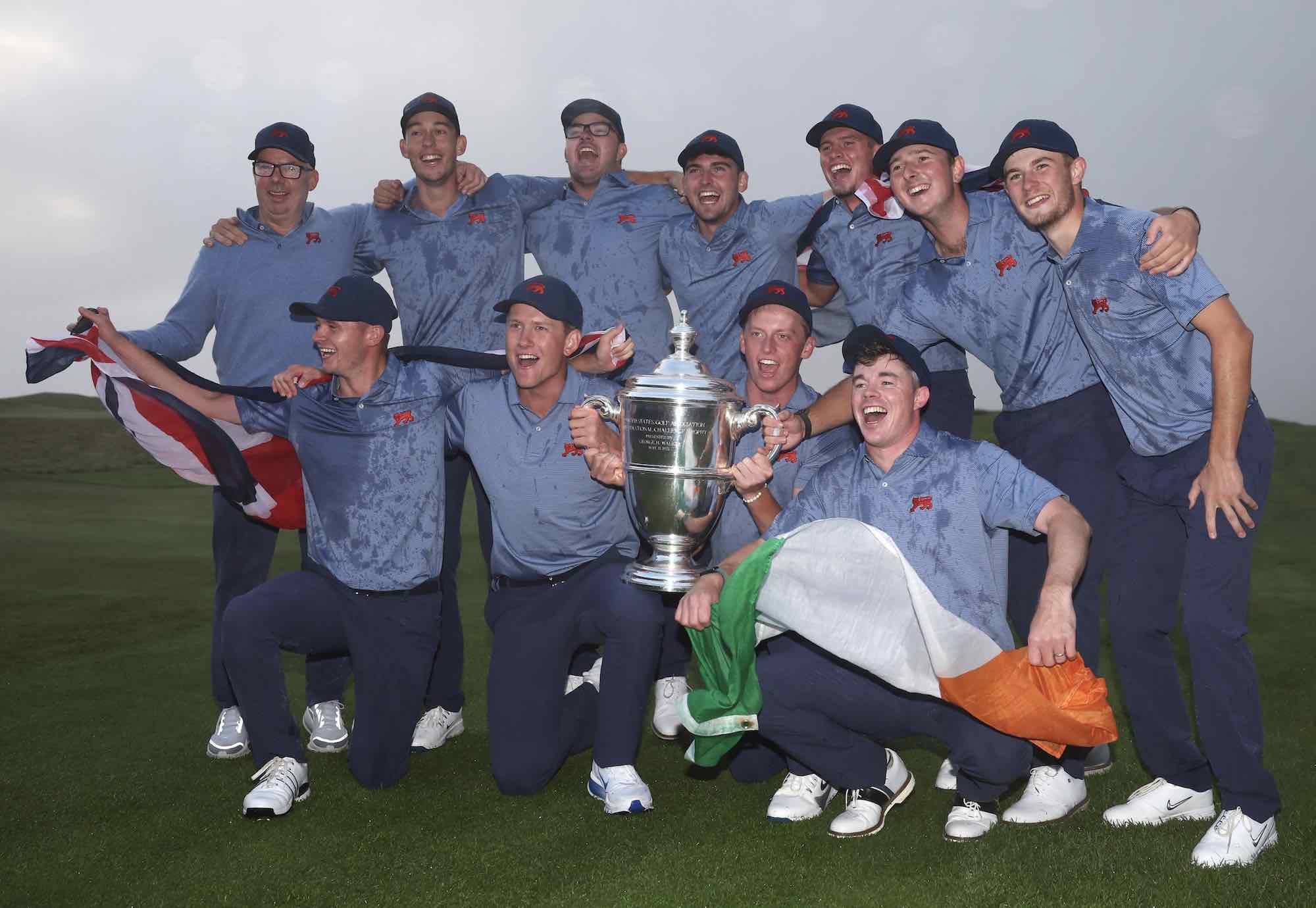
Eleven years waiting to finish hanging on to a putt on the final green. Great Britain and Ireland reclaimed the Walker Cup in Lahinch on Sunday with a victory over the United States by 13½–12½. At midday, the home side had just lost all four foursomes. A few hours later, they were celebrating the triumph around Josh Hill. Same team. Same course. Same day. A world of difference.
The reference to that José María Olazábal Ryder Cup makes sense: a team on the ropes, a comeback in the singles and a one‑point victory. At Medinah, Europe overturned a four‑point deficit to win 14½–13½; in Lahinch, the British and Irish needed to make up three with ten matches to play. And a Poulter even appears in the cast.
The scale of the victory begins with the wait. Great Britain and Ireland had not lifted the cup since Royal Lytham & St Annes, in 2015. Since then they had put together five defeats in a row. The United States arrived in Ireland with a recent superiority that threatened to turn every new edition into a sort of Presidents Cup.
In fact, the debate about adding continental Europe had resurfaced before the match. It has been put on the table by specialists. For that reason it can be said that Lahinch has given the tournament a much‑needed result: a rivalry needs the outcome to retain uncertainty. This Sunday was a breath of fresh air.
And yet the morning suggested exactly the opposite.
The Europeans had finished Saturday ahead, 6½–5½, but the United States’ clean sweep in the foursomes turned that lead into 6½–9½. Ten singles remained and the arithmetic clearly favoured the visitors: they needed three and a half points to retain the trophy. The home side needed seven to take it back. A tie would not have been enough either.
The response was to win the first four matches in the order of play. Stuart Grehan beat Preston Stout by 2&1; Luke Poulter beat Ethan Fang by 3&1; Jack Whaley overwhelmed William Jennings by 8&7, and Tyler Weaver defeated Jay Leng Jr. by 4&3. That start put Great Britain and Ireland ahead, 10½–9½. The comeback was feasible.
What Whaley did deserves a few seconds’ reflection. The US Amateur champion settled his match in eleven holes. His 8&7 equals the second largest margin of victory recorded in an 18‑hole singles match in Walker Cup history. On an afternoon when almost everything would end up depending on a few centimetres, he managed something incredible.
Grehan, meanwhile, completed an unforgettable weekend against the world No. 1. The 33‑year‑old Irishman had already beaten Stout on Saturday after being three down after three holes and, still, two down with three to play. He won the last three. On 18 he holed a putt of about four and a half metres and ended up speaking to the television with his son Kai in his arms, surrounded by fans. “What a roar”, he summed up about the crowd’s reaction. Grehan is an amateur, but a veteran, he is already 33 years old. What a season.
And there was Luke Poulter. It’s impossible not to think of his father, of those five consecutive birdies with which Ian kept Europe alive on the Saturday at Medinah. Fourteen years later, it was his father’s turn to enjoy his son’s victory and another collective reaction. He described the experience as “absolutely thrilling”. The surname helps make the connection.
But winning the first four matches didn’t settle the afternoon. The United States added Ryder Cowan’s victory over Ben Bolton and Josiah Gilbert’s over Sam Easterbrook. To complete the turnaround, the home side still needed results in matches that were open, some under rather precarious conditions.
Niall Sheils Donegan rescued half a point against Kihei Akina after being behind for much of the match. Eliot Baker beat Stewart Hagestad with a birdie at 18. And Connor Graham produced a comeback within the comeback: he was three down after eleven holes against Miles Russell and ended up making five birdies in the last seven. Two of them came just when he could no longer afford anything else, on 17 and 18, to save the tie. Incredible.
That half point from Graham, with only one match left, allowed Great Britain and Ireland to continue depending on themselves to win. Had he lost, not even a later victory from Hill would have been enough to recover the cup.
Hill remained against Tyler Watts. 12½–12½ on the overall scoreboard and the final match tied when they reached 18. Robertson told him they needed the win before he played from the bunker next to the green. Hill played the ball out and left himself a putt of approximately 90 centimetres. Put yourself in his shoes. Eleven years after the last Walker Cup victory. “I just tried to putt it quickly”, he explained. He holed it. He won the hole, the match and the Walker Cup. “There can’t be anything better than this”.
Great Britain and Ireland had just completed the biggest comeback in their history in the competition.
The 7–3 in the singles, built with six wins and two halves, had been exactly what they needed. Nothing was spare. Neither the point decided in eleven holes by Whaley, nor the one Baker wrested on the last, nor Graham’s two final birdies. That dependence on every team‑mate is one of the reasons these competitions are so exciting.
The Walker Cup still has a historical record heavily in favour of the United States: 40 victories to Great Britain and Ireland’s ten and one tie. Lahinch does not erase that difference. But it does add an afternoon that will be remembered for a long time and returns to the next edition a question every great rivalry needs to keep open: who is going to win