


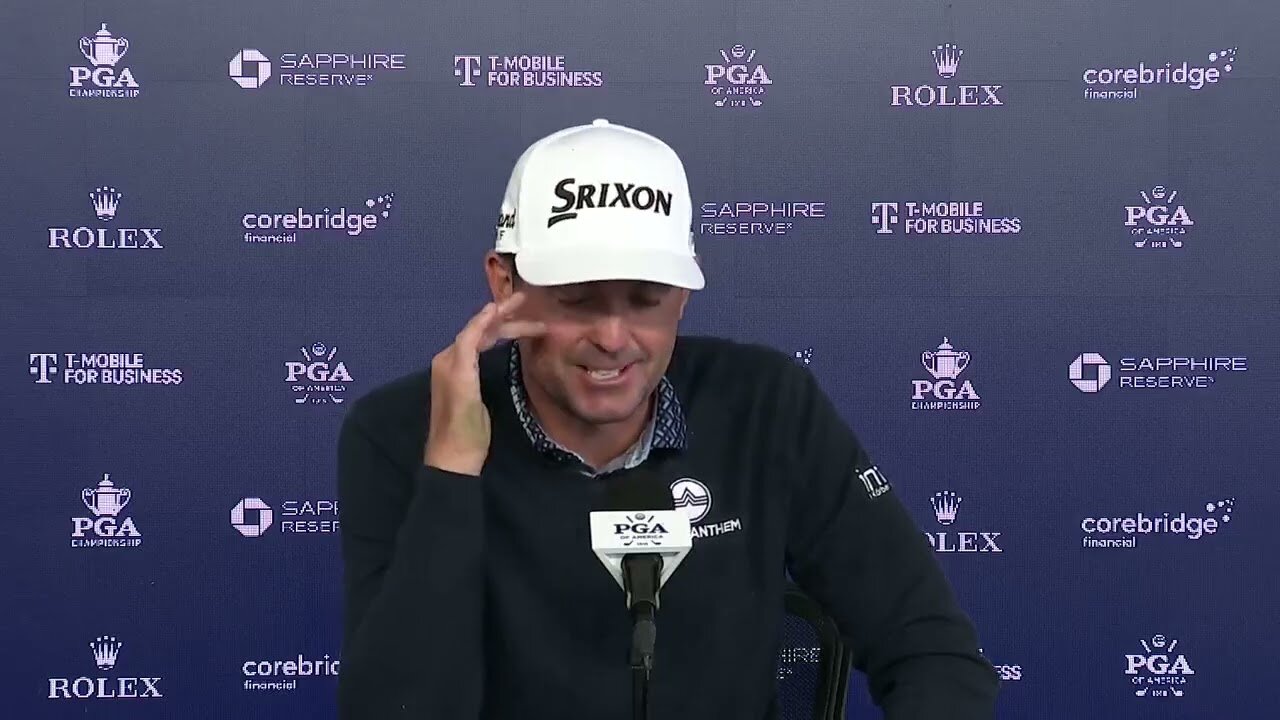
Keegan Bradley stepped back onto Aronimink and was instantly taken back to one of the most important moments of his career. It wasn’t his historic PGA Championship in 2011 as a rookie at the Atlanta Athletic Club, but that 2018 victory at the BMW Championship, on the course that this week serves as host of the year’s second major and that restored his hope when he felt most lost. “I was in a really dark place with the putter, and here I had the first glimmer of hope”, the American admitted ahead of the tournament that starts this Thursday.
Bradley, one of the big names in American golf over the past decade and the most recent captain of the United States Ryder Cup team, spoke with brutal honesty about what that victory meant. “I didn’t know if I would win again on the PGA Tour“, he admitted. “And then all of a sudden I win here, with my family, with my son Logan still a baby running onto the green… It was a dream”, he recalled.
But beyond the trophy, what really marked him was how he reacted under pressure after years of doubt: “I remember thinking on the last holes: ‘I can’t believe how calm you are’. And that’s not something I tell myself very often”.
That Sunday also left an indelible image in his memory. Bradley was leading the tournament and, from the 8th green, he looked up towards the 10th and saw a Tiger Woods dressed in red and black, just one shot behind. “I thought: ‘This is crazy. I’m back here again and my idol is coming after me trying to catch up'”. For Bradley, that meant much more than a simple victory: “I was proud to have put myself back in that position”.
The American also opened up about the emotional after-effects that the last Ryder Cup at Bethpage still left him with. Although he said he feels better, he admitted he still carries difficult thoughts. “I’m still driving and suddenly things come into my head. I think about things I did or that I wish I had done differently”, he explained.
Little by little he feels he is recognising himself again as a player. “I’m starting to feel more like myself. I’m playing better and I feel more mentally separated from Bethpage“, he asserted. And although for a long time he wanted to distance himself emotionally from everything related to the Ryder, he is now excited again about playing another one: “What a story it would be to play the Ryder Cup in Ireland at 41… I would love to play for Jim Furyk”
Bradley also spoke with great emotion about what the PGA Championship means to him, not only as a champion but because of his family roots. His father was a PGA professional and the one who introduced him to golf: “PGA of America has been very important in my life. My father taught me this sport and gave me the opportunity to practise from a young age”.
Precisely for that reason he considers this major’s identity special: “The PGA Championship has no agenda. At the US Open they want to make it extremely tough, almost unfair. At The Open the weather rules and the Masters is simply the Masters. Here they just want to organise a great tournament and I think they do it incredibly well”.
On Aronimink, Bradley warned that everything will revolve around the Donald Ross greens. “You have to be extremely precise. There are holes where you can leave it four metres from the flag and the ball ends up rolling off the green”, he detailed. He singled out the 11th and 17th holes as two of the great judges of the championship: “The 17th is brutal. From the new tee it practically plays like a par 4”.
But perhaps the most human and endearing moment of the whole appearance came when he remembered how he celebrated his 2011 PGA Championship. A story as absurd as it was wonderful: “We left the Atlanta Athletic Club with the Wanamaker on my lap thinking: ‘This is crazy’. We tried to find some beers, but everything was closed. So I ended up having Bud Light and cereal for dinner”.
Bradley still has that photo at home. “It was the best meal of my life”, he said with a laugh. “One minute I was a rookie and the next I was a major champion. I woke up the next day, looked at the trophy beside my bed and thought: ‘I can’t believe this is real'”, he recalled.
At 39, with many emotional scars and the feeling of having survived some of the toughest moments of his career, Bradley returns to Aronimink as a different player. Maybe more vulnerable. Maybe more human. But also more grateful than ever to still have chances to fight for a major