

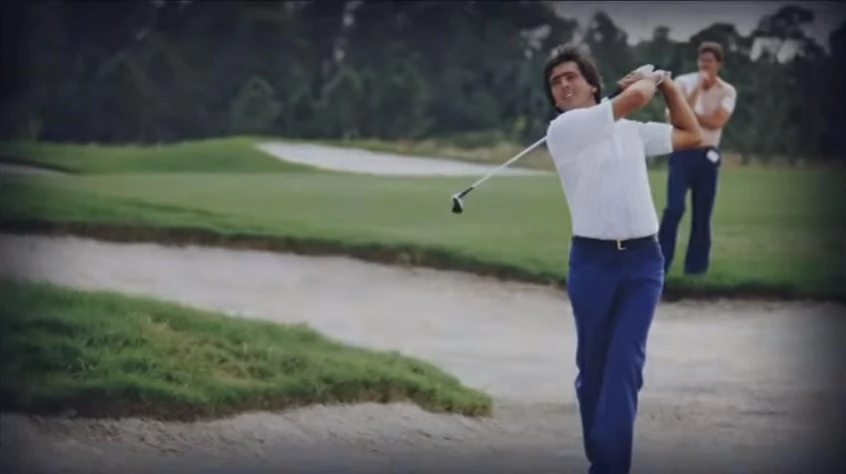
(On 22 February 2022, TenGolf published the story of a legend. The third shot by Seve Ballesteros on the 18th hole of the PGA National during his singles match against Fuzzy Zoeller. A shot that Jack Nicklaus described as the best he had ever seen live. Well, the commitment is that whenever a tournament is played at the PGA National, like this week with the Cognizant Classic of the PGA Tour, it’s time to revisit the story of this legendary moment).
The 18th hole of the Champion course at PGA National (Palm Beach Gardens, Florida) is one of the most recognisable in the annual high-level golf calendar, precisely because it is an exciting setting where the Honda Classic, the tournament that starts this Thursday, is usually decided each year. It is not part of the famous Bear Trap (holes 15, 16, and 17), but it remains an iconic and crucial point.
It is a par 5 of 556 yards, just over 500 metres, with water on the right flank from the tee to the last edge of the green, whose Sunday flag almost leans into the lake. The second shot, therefore, if aiming to reach the green in two, is one of those risk and reward shots, especially on the final day, as a slightly heavy or overly open ball can end up in the water.
On this 18th hole, as many know, one of those shots took place that leaves a mark and fuels myth and legend. The protagonist, Seve Ballesteros. The setting, the 1983 Ryder Cup, in the final hole of the singles match between the Spaniard and Fuzzy Zoeller. As there are no images of such a marvel, the versions are not all exactly consistent. Moreover, that original 18th hole no longer exists as it was in 1983, since Jack Nicklaus undertook a deep redesign in 2002, even fewer references are available to accurately tie up the story.
But perhaps the time has come to do so, by resorting to all the sources that the vast ‘archive’ of the Internet provides us, also appealing to common sense and with the necessary patience to eliminate the less reliable data in the confrontation of all of them.
The context. Seve was leading Zoeller with authority in the first singles match of the day, and that’s why there are no images of the duel. At that time, the television broadcast was not at all complete, from the first to the last match, and in fact, the live coverage began with this match already finished. But Zoeller reacted from the 11th hole and won holes 12, 13, 15, and 16, as recalled by Nick de Paul, Seve’s caddie at the time, and after tying the 17th (which, like today, was a daunting par 3, with a water hazard in between, although the Golden Bear’s redesign brought the green closer to the lake, making it even more daunting), they reached the 18th tee with the match tied and everything to play for.
On the 18th hole, the moment of truth. Zoeller’s drive, according to De Paul, went to the fairway. Seve’s… A hook to the left that took the ball to deep rough on the left. From there, he tried to hit a 4-iron to gain as much ground as possible, but the shot was faulty and barely advanced a few dozen metres, and the ball also ended up in a bunker on that left side of the fairway. Today, this sand trap, as it was exactly, does not exist, although it hasn’t changed that much, as seen in the historical photographic comparison (courtesy of Google Earth, by the way). If you look closely, you can see that the distance from the bunker to the green is very similar to the current one. It is also noticeable how the bunkers on the right side disappeared, which can be glimpsed in the photo of Seve’s shot, behind the Spaniard.
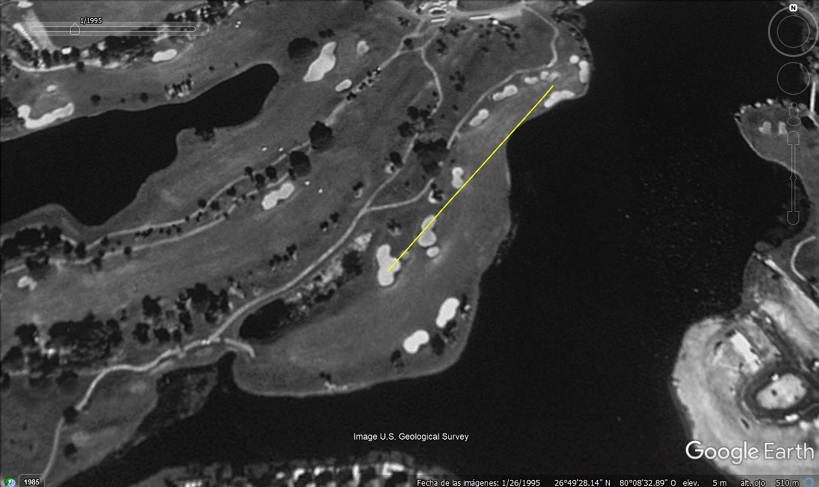
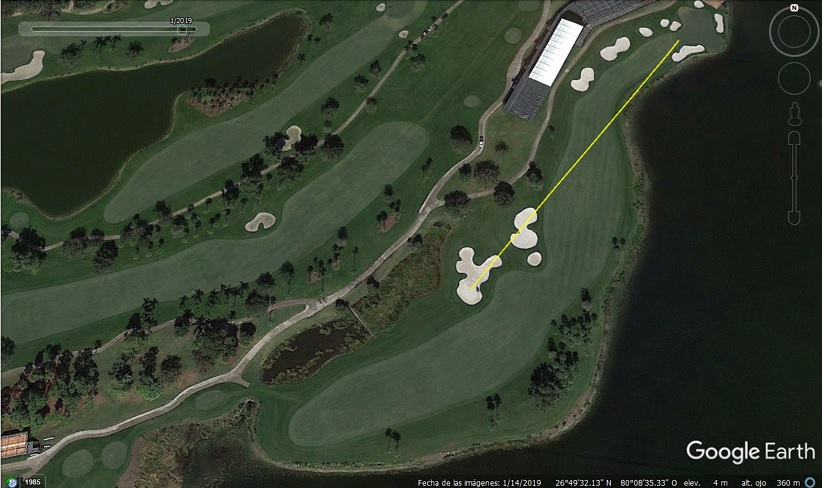
The ball was situated in the bunker about four or five metres from a slope that rose approximately one and a half metres high and 245 yards from the green. Zoeller saw the situation so well that he preferred not to take risks, hitting an iron to leave himself a comfortable third shot with a wedge. In such a situation, Seve and his caddie thoroughly assessed the situation, and the Spanish magician asked for his battered Toney Penna 3-wood… The rest is history, although there is no plaque to remember and commemorate it. Seve hit a simply perfect shot, finding the very sweet spot, quickly putting the ball in high flight and taking it to the very entrance of the green. Zoeller had a putt of about three metres to make the birdie, but he didn’t convert it, and Ballesteros, with two putts, tied the hole, and the match ended in a draw.
At this point, it is worth recalling the explanation provided by the Scottish player Ken Brown, Seve’s teammate in that European Ryder team, to accurately place the challenge’s dimension. Brown pointed out that in those days, with those woods, very few managed to fly even 240 yards with a 3-wood. And that, hitting from the tee! However, Seve exceeded that flight distance from the sand, threading an open little wood, as his ball came out very much to the left (in fact, before hitting, he asked the spectators on that side to move a bit) and it kept opening, opening until it landed on the green, always avoiding the permanent water hazard that accompanies the entire hole on the right.
There are a couple of photos attributed to that moment, and indeed, they seem to capture it, one of which opens this report and appears in the video. It is a real shame that there are no more images of the shot that Jack Nicklaus, captain of the US team in that Ryder and a witness to the event, did not hesitate to signify as the best he had seen in his life. He might have remembered it when redesigning the course and perhaps proposed some reminder…
According to some versions, Seve’s ball flew over the water, but it really seems impossible if we adhere to the testimonies indicating that the ball even left the bunker on a line pointing thirty or forty metres to the left of the target, the green.
Some still say that Seve hit the second shot in that bunker and tied the hole with a birdie, but there is no doubt about it. It has even been suggested that Zoeller also went to the rough off the tee, although in a better position than Seve, and therefore sought the green in three. In this case, it seems reasonable to trust Nick de Paul, who assures that his tee shot went to the fairway.
There also seems to be no unanimity on the distances Seve handled with the putter on the green, but the flag was at the back and to the left that day (it was a different green from today), and it seems the Spaniard hit a first putt of about fifteen metres, with his ball at the entrance of the green (some even talk of a chip and putt, but it was two putts).
More curiosities, to finish. Langer has also said at times that it was the best shot he ever saw… But he couldn’t have seen it, as he was playing two matches behind Seve and finished his duel against Gil Morgan on the 18th. Nick Faldo has also referred to this almost legendary event in some interview… The Englishman was playing in the second singles match of the day, right behind Seve and Zoeller, but he won his duel against Jay Haas on the 17th green, so it’s possible he had time to see the shot.
By the way, Seve played the Honda Classic seven times, but obviously never at the PGA National, which has been the tournament’s venue since 2007. This week, for example, when the star match on Sunday walks down the 18th fairway, perhaps we can open a parenthesis and try to imagine Seve there, on the left flank, in a bunker that doesn’t exist today but over which a new, wider one was placed, asking Nick de Paul for the 3-wood. And the caddie closing his eyes and searching for an urgent prayer.
Note: The fact of dwelling so meticulously on a shot like this is perfectly justified by the dimension that Severiano himself gives it, considering also that it did not serve to win a tournament, a Major, a Ryder, or even his own individual point. This is how the Spaniard valued it in his autobiography: “Jack Nicklaus, who was the captain of the American team and was already rubbing his hands seeing me in the sand, later came up to me to say: Seve, it’s the best shot I’ve seen in my life. What a compliment! Whether Jack said it from the heart or because he was happy to have won the Ryder, I don’t know. I do know that, unlike my friend Gary Player, Nicklaus is not given to exaggerated praise. I also know that if I had to choose one of all the good shots I’ve made in my career, it would be this one. I think, for many reasons, it is superior to the chip at Birkdale in 1976, more than the second shot on the 2nd hole of the final round of the 1983 Masters, and more than the chip on the 18th hole of the 1988 Open Championship”.