
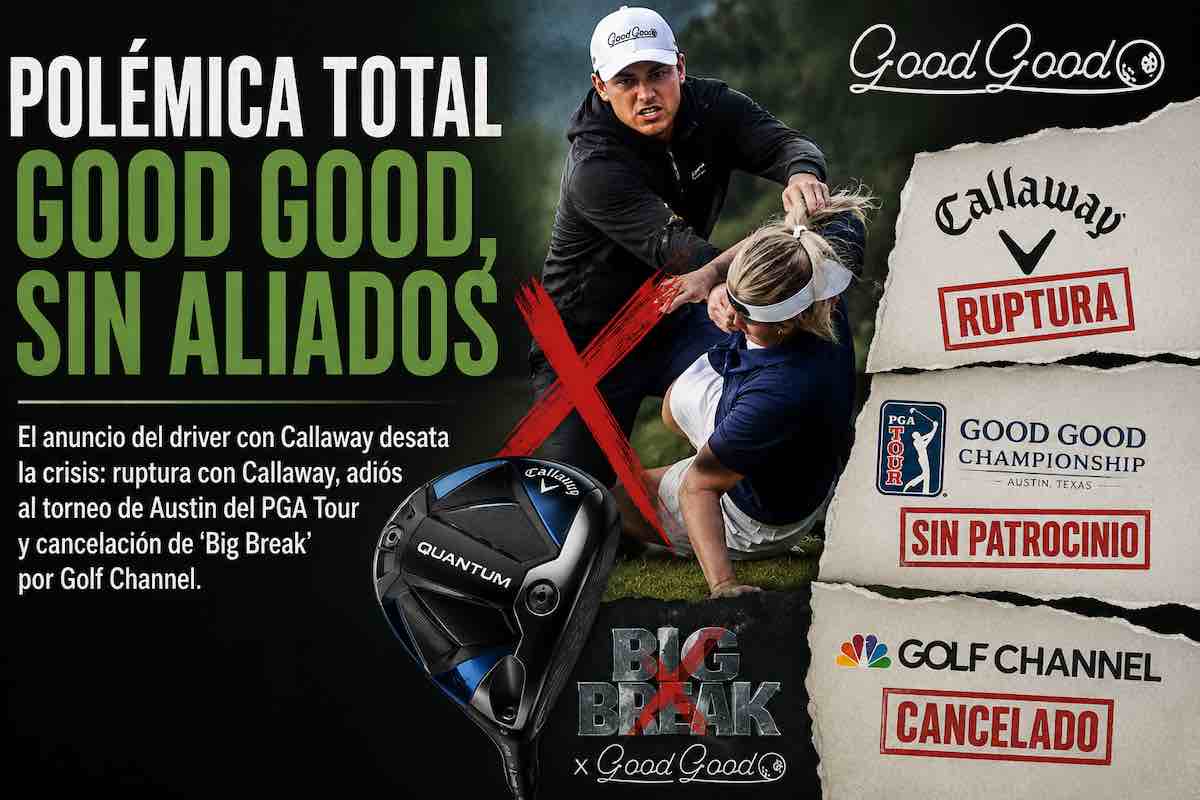
A video of barely a minute has sparked an earthquake around one of the most influential brands of the new digital golf. The scene of Garrett Clark knocking down Alexis Miestowski to prevent her touching his new driver unleashed a wave of criticism that the initial apologies could not stop. Callaway, which had approved and shared the ad, has ended a three‑year relationship; Good Good has withdrawn from naming the new PGA Tour event in Austin; and Golf Channel has cancelled the season of ‘Big Break x Good Good’
Good Good Golf took six years to go from being a YouTube channel created by a group of friends to becoming one of the major commercial players in modern golf. It took just a few days and an advert of about a minute to put much of what it had built at risk.
The sequence of events has been dizzying. A video intended to promote a driver developed with Callaway ended up provoking a crisis that has left Good Good without its main equipment partner, out of the sponsorship of a new PGA Tour event and without the major television project that was meant to consolidate its leap from the internet to traditional TV.
It has also led to the withdrawal of its products from major retail chains and forced the top executives of Good Good, Callaway, the PGA Tour and Golf Channel to intervene publicly.
It all began with an advertising idea that no one stopped in time.
What Good Good Golf is
Good Good is not simply a group of young people who post golf videos.
The company was founded in 2020 after Garrett Clark and Matt Kendrick met at a tournament and shared the idea of building a communications and entertainment business centred on golf. From Clark’s popularity, Stephen Castaneda, Matt Scharff and other creators, the project developed a format based on matches, challenges, humour and competitions designed for a young audience.
Its growth was extraordinary. Good Good expanded its activity from YouTube into clothing, accessories, golf equipment, live events, player sponsorship and television productions. In October 2025 it claimed to have more than four million followers across its networks and, a few months earlier, had closed a funding round of US$45 million, led by Creator Sports Capital with participation from Omaha Productions, Peyton Manning’s company.
Callaway had very early on identified its ability to connect with a generation of golfers not always reached by traditional media and campaigns. The relationship began in 2023 and Callaway itself then described Good Good as an engaging and inclusive content platform capable of broadening the brand’s reach within what is called Modern Golf.
Golf Channel followed a similar path. After broadcasting the Good Good Desert Open and the Good Good Midwest Open in 2024, the network formally expanded its collaboration in February 2025. The explanation was simple: the group’s dynamic, laid‑back content connected with a young, passionate audience.
The crescendo arrived with the PGA Tour.
In October 2025 the creation of the Good Good Championship was announced, a new FedExCup Fall event that was to be held from 12 to 15 November 2026 at the Fazio Canyons Course of Omni Barton Creek in Austin. It would feature 120 players, award 500 FedExCup points and be broadcast on Golf Channel, PGA Tour Live, SiriusXM and the international feed of the circuit.
It was Good Good’s first direct relationship with the PGA Tour, its first sponsorship of a professional event and an agreement planned for several seasons. The company had stopped merely talking about professional golf: it already had its own tournament within the PGA Tour.
That was the position the company occupied before publishing the advert.
The video that blew everything up
The ad appeared on the social channels of Good Good and Callaway on the night of 20–21 August. Its purpose was to promote one of the new Quantum drivers developed jointly by the two brands.
According to Good Good’s executives, the piece was intended as a parody of the horror film Obsession. The idea was to show just how obsessed Garrett Clark was with his new club.
The execution was very different.
In the video, Alexis Miestowski, a former Indiana college player and contributor to Good Good’s female‑focused content, approached Clark’s bag and tried to take the driver. Clark came running, shoved her violently and knocked her to the grass.
He then stood over her and said in a threatening tone:
“Don’t touch my new driver”
The recording continued with another man taking the club while Clark watched the scene. The piece lasted about a minute and had been produced by Good Good, but it did not appear online without external oversight: Callaway later acknowledged that it had reviewed, approved and shared the video before its publication.
The reaction was almost immediate. Numerous fans, journalists and figures connected to golf considered that the scene trivialised or used violence against women as entertainment. The criticism was especially damaging for two companies that had presented their relationship as a way to build a more open and inclusive golf.
The video was removed that same night, but by then it had already been saved and began to circulate independently across social media. Pulling the original post did not prevent it being reshared nor did it stop the controversy.
An initial apology that was not enough
Good Good published its first official statement on Saturday 22 August.
The company admitted the video showed actions incompatible with its values, confirmed its removal and offered apologies. It also said its mission remained to make golf more inclusive for everyone.
Callaway issued its own apology. However, the first responses did not sufficiently clarify how a piece of that nature had passed through all the production, marketing and approval filters of two different companies.
They also did not precisely explain who had made the decisions.
Good Good’s chief executive, Matt Kendrick, ended up accepting responsibility. He acknowledged the company should have had stronger controls and announced a review of creative processes. For an indefinite period, Kendrick himself would personally oversee content published by the communications and marketing departments.
Good Good also announced it would donate all proceeds from sales of the driver linked to that campaign to a local women’s support organisation.
Callaway also had to raise the level of its response.
Its chief executive, Chip Brewer, expressly acknowledged that Good Good had produced the ad, but that Callaway had approved it prior to publication. That authorisation, he said, should never have happened. The company opened an investigation and announced changes to its internal procedures.
The problem was no longer only the piece. It was also the sense that the initial apologies had been generic, late and more concerned with limiting the crisis than explaining what had happened.
The PGA Tour turns up the pressure
On Tuesday 25 August, during TOUR Championship week, the PGA Tour’s chief executive, Brian Rolapp, was asked directly about the case.
His response turned a social media controversy into a very concrete business threat.
Rolapp said the video was not aligned with the PGA Tour’s values and acknowledged that Good Good’s first reply had seemed insufficient. He described it as “defensive and late”. He also explained the circuit was in talks with the company and would continue to assess the situation.
When asked about Good Good’s continuity as sponsor of the Austin event, Rolapp described the matter as a “fluid” situation.
The choice of words made clear the championship’s name was already in jeopardy.
The PGA Tour had backed Good Good to connect with younger followers and to experiment with a different way of presenting one of its tournaments. However, it also had to protect the image of an official competition and of the other sponsors involved.
The experiment was beginning to crumble before its first edition took place.
Golf Galaxy forces the first change in ‘Big Break’
That same Tuesday the premiere of Big Break x Good Good, the revival of one of Golf Channel’s best‑known shows, was scheduled.
Big Break first aired in 2003 and had been off the schedule since 2015. Its return, associated with Good Good, was to mix the traditional challenge format for aspiring professionals with the aesthetics and members of the popular creators’ group.
The main prize was particularly important: the winner would receive an invitation to play the Good Good Championship on the PGA Tour in Austin.
About two hours before the premiere, Golf Channel announced it was postponing the programme until 1 September. One of the sponsoring brands had requested that all its visual presence be removed from the series and the network needed time to re‑edit the episodes.
Golf Channel did not officially identify the company, although Associated Press and other media pointed to Golf Galaxy, listed as presenting sponsor.
The commercial reaction was even wider. Dick’s Sporting Goods and Golf Galaxy removed Good Good products from both their stores and their online platforms, according to Reuters and Associated Press.
The video was already affecting equipment, clothing, television and the PGA Tour event simultaneously.
Garrett Clark breaks his silence
On Wednesday 26 August, Garrett Clark posted a video of more than eight minutes to personally accept responsibility.
Clark called the piece “the worst advert known to man”, admitted the idea had been awful and said he felt ashamed when he saw the final result. He also stated he did not support any form of domestic violence or abuse and that the critical reaction was justified.
Good Good’s founder showed footage from the shoot to explain it had been a staged scene and that Miestowski had not suffered the blow implied by the final edit.
However, that did not solve the main issue. The controversy had not arisen because viewers thought they were watching a real assault, but because two brands had made the depiction of an assault on a woman the central idea of a marketing campaign.
Clark also asked for the abusive messages directed at Miestowski to stop, as she had begun receiving attacks on social media despite being the person knocked down in the ad. The creator reiterated that one of the company’s objectives was to contribute to the growth of women’s golf.
His intervention was much more extensive and direct than the initial corporate statement, but it arrived when several decisions already seemed inevitable.
Callaway ends a three‑year relationship
On Thursday 27 August, Callaway terminated its relationship with Good Good with immediate effect.
The company said it had heard personal accounts from women affected by violence and stated that such behaviour must never be normalised, trivialised or used as entertainment.
Callaway acknowledged that later measures did not erase the harm nor remove its responsibility. In addition to ending the agreement, it announced internal corrective actions, the strengthening of its approval systems and a contribution of US$1 million to organisations dedicated to preventing violence against women and supporting victims.
The split ended a partnership begun in 2023 that had gone far beyond a simple communications campaign. Good Good used Callaway equipment, both brands sold jointly developed products and they had just launched the range of drivers and balls that were to feature in this new phase of the relationship.
Callaway thus distanced itself from Good Good, but it could not present itself as unrelated to the origin of the problem. Its own chief executive had admitted the company approved the ad and that its internal process failed.
The final decision was decisive, although it came after the campaign had passed through all its filters.
Good Good relinquishes the Austin tournament naming rights
Shortly after Callaway’s decision became public, Good Good informed the PGA Tour it was withdrawing as title sponsor of the Austin event.
The company explained that, after conversations with the circuit and internal reflection, it needed to focus its efforts on its team, corporate culture and the changes necessary to learn from what had happened. It also said it would try to regain lost trust and hoped to work with the PGA Tour again in the future.
The circuit supported the withdrawal.
In its statement, the PGA Tour said Good Good should use this period to review its organisation and reiterated its conviction that golf should bring people together and create a welcoming environment for everyone.
The tournament has not been cancelled.
It will be held from 12 to 15 November at the Fazio Canyons Course of Omni Barton Creek as planned, but now appears on the circuit’s page under the provisional name Austin Championship. The PGA Tour will announce its new sponsorship plans later.
Good Good has therefore lost the project that was to symbolise its definitive entry into traditional professional golf even before staging the first edition.
Golf Channel cancels the entire season
The withdrawal from the tournament triggered another immediate consequence.
The winner of Big Break x Good Good was to receive an invitation granted by the sponsor to participate in the Good Good Championship. With Good Good removed from the competition, Golf Channel judged it could no longer deliver the planned outcome for the series.
The network moved from postponement to the complete cancellation of the 2026 season.
Golf Channel particularly regretted the situation for the twelve contestants and the work done by the production team, but explained that recent events and the impossibility of awarding the original prize prevented completing the show as conceived. Big Break will return in 2027.
A nuance is worth noting. Golf Channel has not formally announced it will never work with Good Good again, nor has it communicated a general, indefinite split from all potential agreements.
What it has ended is the most important project they shared: Big Break x Good Good will not air in 2026 and the network speaks of the show’s return next year, but does not guarantee Good Good will remain associated with the format.
From a major gateway to the PGA Tour to a total crisis
The scale of what happened is clearer when comparing the current situation with that of less than a year ago.
Good Good had achieved something unprecedented for a YouTube‑born company: a US$45 million funding round, proprietary products sold in major chains, a strategic relationship with Callaway, live events broadcast by Golf Channel, the revival of a historic TV franchise and title sponsorship of an official PGA Tour event.
In less than a week:
Callaway has ended the partnership with immediate effect.
Good Good has relinquished sponsorship of the Austin event.
The PGA Tour has removed its name from the championship.
Golf Channel has cancelled Big Break x Good Good.
Golf Galaxy requested removal of its branding from the show.
Dick’s Sporting Goods and Golf Galaxy pulled their products.
The company has had to review its internal structure and approval mechanisms.