


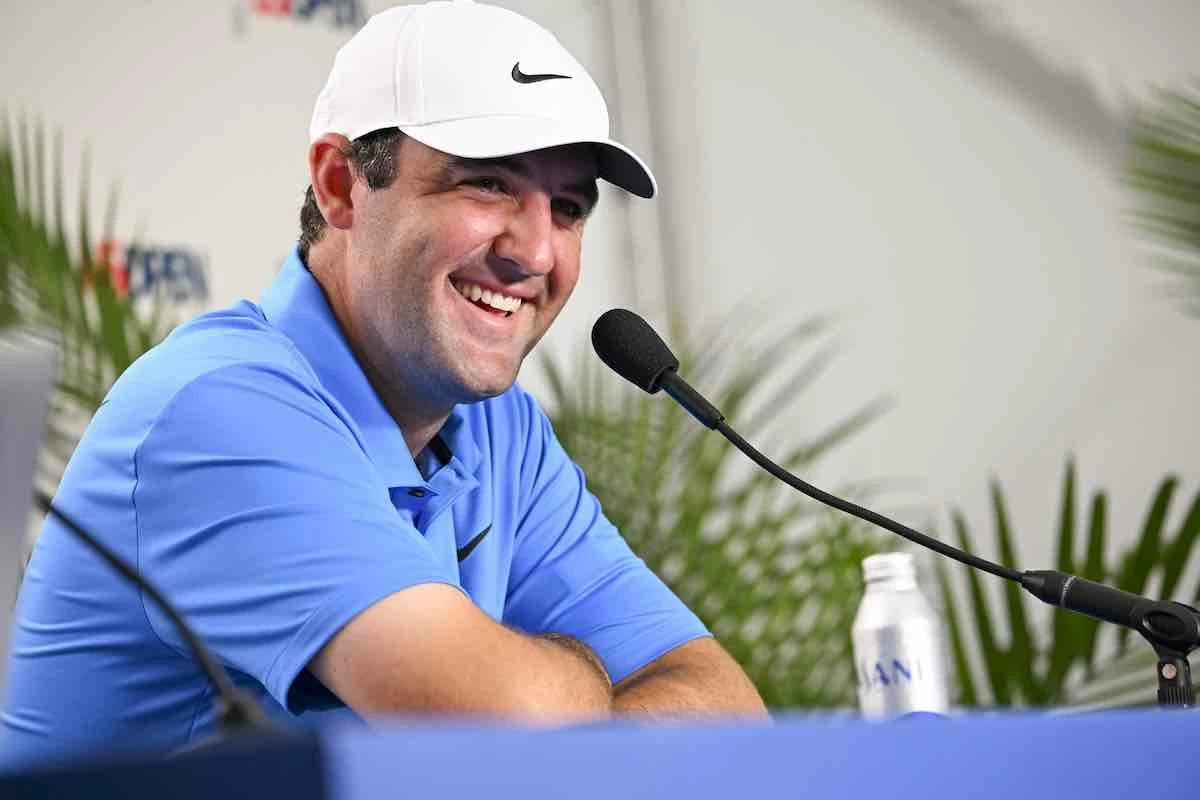
One of the great virtues of Scottie Scheffler is to simplify things. He does it daily. On the golf course and off it. He applies common sense, doesn’t get into messes and avoids complications. No one doubts that he is currently the best golfer in the world. By far. A beast. Well, this gentleman has been asked to freely offer the best advice that comes to his mind for an amateur player. If you are from the Put a Scottie Scheffler in your life club, you already suspected it, but we anticipate that he does not disappoint. Simple, but definitive. See.
“I think golf is largely about trial and error, learning what shots work and which ones don’t. Much of it is due to practice and preparation. So, when I hit a shot in a tournament, it’s not a shot I haven’t hit before. When I’m on the golf course, I never try to do something I haven’t done before. I always look back and remember how I practiced that shot and it comes out because it’s something I’ve done before. I never do anything that is out of the ordinary for me,” assures the world’s Number One.
Surely, dear amateur, you see yourself reflected in this comment. How many of us try a shot we have never practiced and, moreover, we get frustrated because we can’t do it. It is obvious that an amateur golfer is not going to practice the same hours as the world’s Number One, but life on the golf courses would go much better if we could simplify things like Scheffler does. (Clarification for the most daring: it is not the same to have practiced a shot on the range as to see it in a professional golf tournament). In the end, it’s about knowing your own limitations.
Following this line, Scheffler’s mentality is an example, a good path to follow, also for top-level golfers. Why does he never lose his temper or at least manage not to show it? “I always try to remind myself that I should commit to what I can control and I don’t worry about the results. I try to do my best to execute the shot. I know and assume that over the course of a 72-hole tournament, I’m going to have a lot of good and bad shots,” he points out.
But of course, this does not mean that he settles. On the contrary. Ambition runs rampant in his veins. Here Scottie offers another treatise on how to tackle challenges. “I no longer think about my victories. I only think about this week and preparing to play. The fact that I won last week doesn’t give me any advantage over the rest this week. We all start at the same level and the field levels out again from Thursday. Last week doesn’t matter. When I’m at home I try to be the best husband and father I can be and when I’m out here, I try to be the best golfer I can be. I try to give my best in everything I do, whether it’s training in the gym, practicing here to prepare for a tournament, practicing at home or spending time at home with my friends and family. I try not to think too much about things, live in the moment and soak it all up, because you never know how long it’s going to last. I try to enjoy the good times and fight against the bad ones,” he concludes.
Scheffler, more talkative than usual, probably because American journalism has started to get the hang of the questions, broke a nice lance about his coach, someone who is more in the shadows than is usually the case with athletes of this level. “I think Randy is very good at giving me the right information. I remember that after the first round at the Masters, I didn’t feel good about my swing. I had the impression that I was using all the hands and… I was lucky to make the result I made in the first round based on how I felt my swing. I got to the range and Randy was like, great job, great round, blah, blah, blah… I was like, listen, my swing was bad today. We have to solve this. About five minutes later he gave me a little advice with the grip. I hit a couple of shots and felt exactly what I needed, what I was looking for. From there, everything in my head was over. I felt what I had to feel, hit five more balls and kept playing. Randy has always been very good at not overthinking things and giving me a little advice. I tease him a lot, but he really is a kind of sage when it comes to the swing. He understands my swing very well and where I need to be. Whenever I have a question, he is usually able to give me a pretty good answer and, if not, we resort to the trial and error method.”
As for the course, Scheffler is expectant and excited. He likes Pinehurst. The key, in his opinion, as easy as he sees it and as difficult for the rest of the planet, is to be aggressive when it’s time and patient when there’s no other choice. He feels comfortable with the escape routes. “With rough you always have less margin, but with these bare areas, although they are very difficult, you always have more chances to recover. It’s not that you fail and end up in the water or in an unplayable area. It allows you to be more creative and I like that. The key this week will be patience, without forgetting that there are times when you simply have to hit the shot that is due, a good shot, you can’t escape. It’s a very fun course,” he says.
Finally, as for what has changed in the putt, which he was working on yesterday for more than an hour with Phil Kenyon, Scheffler is clear: “I’m trying to be as visual as possible. Before I used a line on my ball, so sometimes I tried to match the line on the back of the putter with the line on the ball. Sometimes I got a little confused. Nowadays I feel that I am much more visual with what I am trying to do, seeing what I want the putt to do instead of playing guessing games. I put the ball on the ground and align it where I think it should be aligned and then I hit the putt,” he highlights.