

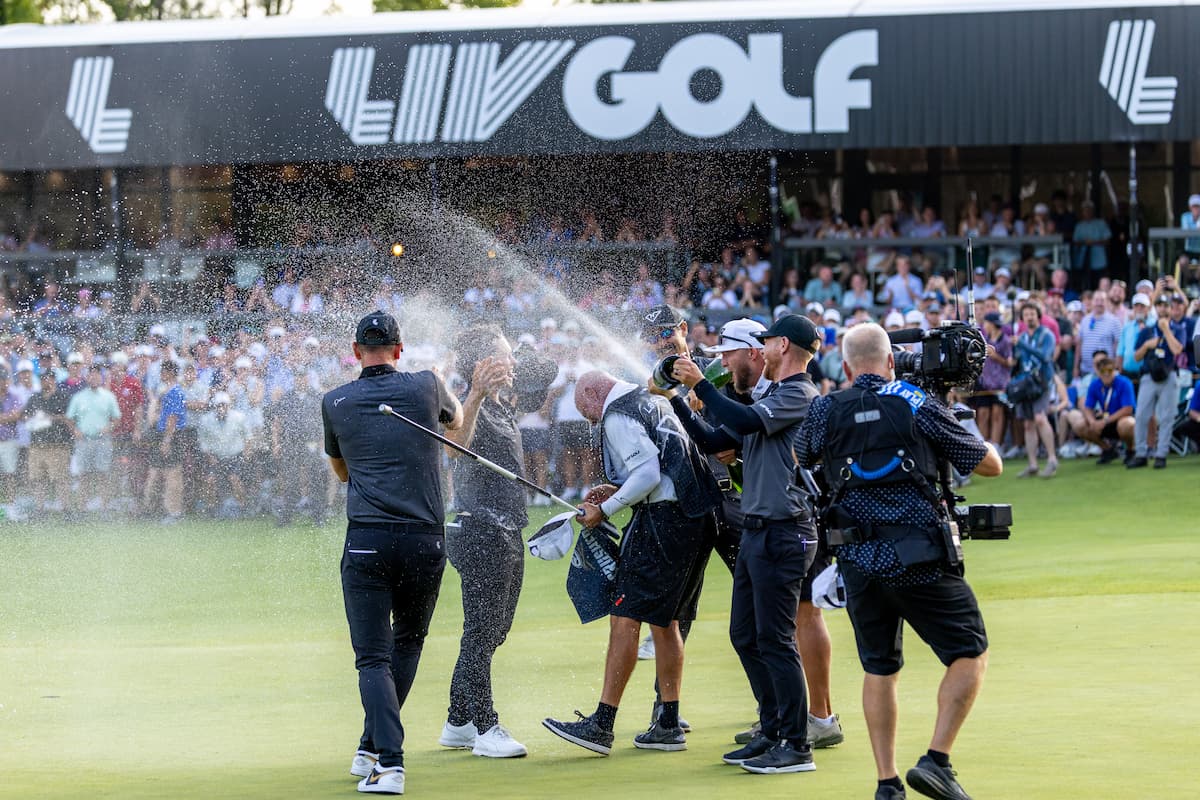
The announced closure of LIV Golf threatens to leave a significant economic hole and many creditors unable to recover a large part of the money owed to them. After the organisation confirmed this Thursday before a court in New Jersey its intention to bring its operations to an orderly close, all eyes now turn to the financial consequences of a bankruptcy that could leave millions of dollars outstanding. And the prospects do not look very encouraging. According to a corporate restructuring expert consulted by the agency Reuters, the circuit may have very few assets with which to meet its financial obligations.
John Sparacino, a lawyer at the firm McKool Smith with more than 30 years of experience in bankruptcy and restructuring proceedings, believes that the creditors of LIV Golf could end up recovering only negligible amounts compared with the debts accumulated. The organisation, which since September had been under Chapter 11 of US bankruptcy law, has finally abandoned its relaunch plan for 2027 after negotiations with BC Partners, the investment firm that had proposed contributing up to $300 million to guarantee its continuity, failed.
The deal was conditional on LIV securing contractual commitments from a sufficient number of major stars. However, the departure of players such as Jon Rahm, Tyrrell Hatton or Sergio García and the lack of agreements with other major figures ultimately frustrated the negotiations. For Sparacino, that rescue attempt was a desperate move from the start, especially given the difficulty of obtaining enough financing and organising a new season with so little time.
DeChambeau has $5.7 million outstanding
One of the main unknowns in the process is what will happen to the amounts that LIV Golf still owes some of its players. That is the case, among others, of Bryson DeChambeau, one of the circuit’s leading figures since its creation, who has approximately $5.7 million outstanding to date, not counting future financial commitments.
The case of Jon Rahm is different. The man from Barrika reached an agreement to terminate his relationship with LIV Golf early that involved giving up about $100 million in guaranteed future payments under his contract. An amount that, therefore, should not be confused with a debt outstanding within the bankruptcy proceedings.
Sparacino warns that creditors’ financial claims could end up being worth far less than the amounts initially recognised. If the available estate proves insufficient, even those entitled to collect millions of dollars might recover only a small fraction of that money.
The expert believes that, given such low recovery expectations, some creditors might even refrain from pursuing lengthy and costly litigation to claim their outstanding amounts.
A circuit with very few assets to liquidate
The main problem for LIV Golf is that, despite the more than $5bn invested by the Public Investment Fund of Saudi Arabia since 2022, the organisation may now have a balance sheet of little value to face its debts.
According to Sparacino speaking to Reuters, sports competitions of this kind typically operate with corporate structures that do not need to hold large tangible assets. In LIV’s case, the main assets likely available for liquidation could be limited to its trademarks, intellectual property rights, merchandising products and certain contractual rights.
The lawyer even questions whether the trade names and other elements of the circuit’s corporate identity could fetch a significant value in a potential sale. He is also not aware of LIV holding significant legal claims against third parties that could generate additional income to satisfy creditors.
This circumstance could mean that the amounts ultimately recovered are much lower than the volume of outstanding obligations, although there is not yet a definitive valuation of the assets nor an official estimate of how much money will be available for distribution.
From restructuring to a possible liquidation
The withdrawal of BC Partners has left the LIV 2.0 plan without momentum, a plan under which the organisation intended to transform its business model, reduce operating costs and give teams and their players a greater economic role.
Sparacino considers that the search for private financing was practically the only realistic alternative. LIV Golf could hardly have accessed conventional bank loans and needed an investor prepared to accept substantial losses during the roll-out of the new competition. According to his analysis, BC Partners appeared to be the only serious financing option, rather than the result of a competitive process among several interested parties.
Once continuity was ruled out, the bankruptcy proceedings could shift from the current Chapter 11, initially used to try to reorganise the company, to a liquidation under Chapter 7 of US law.
This second procedure is usually less costly, although it can change the payment priorities for certain administrative and professional expenses. For the moment, it is a possibility flagged by the expert and not a decision made by the court.
The players’ future, another unknown
The disappearance of LIV Golf also opens an uncertain scenario for golfers who still have contractual ties to the organisation. The closure could allow some to become free to negotiate joining other circuits, although potential financial disputes over outstanding amounts could be prolonged through the bankruptcy process.
In this regard, the PGA Tour is maintaining a cautious stance. Brian Rolapp, its chief executive, has stated that the US circuit will not negotiate with LIV players while they remain bound by their contracts. He has also ruled out, for now, repeating the special reinstatement programme that allowed Brooks Koepka to return.
Thus, the end of LIV Golf does not guarantee the immediate return of all its stars to the PGA Tour, while the outstanding financial claims could become another matter accompanying the competition’s closure.
After a multimillion-dollar investment that transformed the landscape of professional golf, LIV Golf now faces a very different stage. Its sporting future has been practically ruled out and attention is focused on determining the real value of the remaining assets and what portion of the debts can be satisfied. An outcome that, according to the expert consulted by Reuters, could leave many creditors with far less money than they expected to recover.