


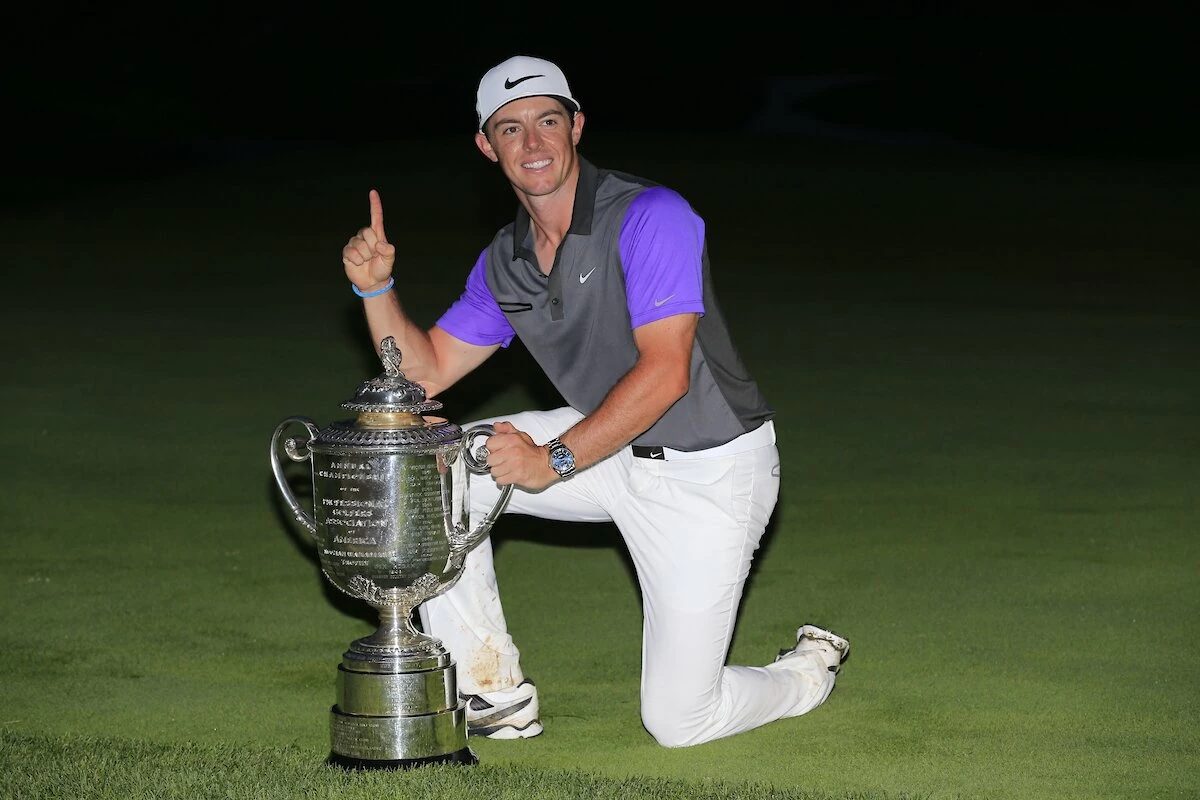
– As the start of the Masters approaches, the name of Rory McIlroy will resonate and resonate like an inevitable echo, as has happened every time over the last decade, since it is the Major that, since he won the Open in 2014, the Northern Irishman has left to complete the Grand Slam. Moreover, as the years have gone by, it weighs (or surprises) more and more among analysts and fans that McIlroy has not sung victory in any of the four majors. It is the yoke that excellence entails.
– Rory will soon turn 35 (May 4), an age at which golfers, especially those of his stature, are still in ‘marriageable age’ for glory, focusing mainly on the Majors, as we will now see. But, in relation to the data provided by history and, therefore, with what the best players of all time were able to do, at what point in his career is the Northern Irishman when his chances of winning one or more majors are analysed? In this regard, some data can be naively provided, analysing the age of the winner of each of the Majors that have been contested to date, since that first Open edition of 1860.
– Up to today, 466 Majors have been contested (151 editions of the Open, 123 of the US Open, 105 of the PGA and 87 of the Masters). And we have a total of 232 different players who have won at least one (only 87 were able to win more than one in over 160 years of history, one of the most exclusive clubs in golf and sport in general). As explained, it is about seeing how old each of these 232 players was when they won each of the majors. The first great conclusion, in view of the data, jumps out on its own:
– The young have always had it very difficult, if not almost impossible: Only four of the 466 Majors were won by a player who had not yet turned 20. A figure that stands at a meagre 0.85 percent of the total.
– Three of these four were won by Young Tom Morris and are the British of 1868, 1869 and 1870; he also won the one in 1872, but he did so at the age of 21. The missing one of the four corresponds to John McDermott, who won the US Open in 1911 before turning 20 (and who would also win the one in 1912 at the age of 20). As can be seen, the history of the Majors has always put an almost insurmountable filter in this age range, before the age of twenty. It has been 113 years since a Major was won by a player who has not yet turned 20.
– Not even the great Bobby Jones could do it (he won his first major, the US Open of 1922, at the age of 21). Interestingly, two Spaniards, Seve Ballesteros and Sergio García, came close, with those second places in the British of 1976 and the PGA of 1999, respectively.
– The other great filter comes logically from the other side. Pay close attention to the data: only on thirty occasions was a Major won after the age of 40 (that is, with 41 already turned). Only thirty out of 466 attempts, just 6.4 percent.
– It is worth revealing the list of the 26 players who added these thirty victories: Jack Nicklaus (Masters of 1986), Tiger Woods (Masters 2019), Gary Player (Masters 1978), Harry Vardon (British of 1911 and British of 1914), Sam Snead (Masters 1954), Lee Trevino (PGA 1984), Phil Mickelson (British of 2013 and PGA 2021), J. H. Taylor (British 1913), Old Tom Morris (British of 1864 and British of 1867), Willie Park Sr. (British 1875), Raymond Floyd (US Open 1986), Ernie Els (British 2012), Henry Cotton (British 1948), Julius Boros (US Open 1963 and PGA 1968), Hale Irwin (US Open 1990), Payne Stewart (US Open 1999), Vijay Singh (PGA 2004), Ted Ray (US Open 1920), Ben Crenshaw (Masters 1995), Mark O’Meara (Masters 1998 and British 1998), Tommy Bolt (US Open 1958), Jerry Barber (PGA 1961), Roberto de Vicenzo (British 1967), Tom Kite (US Open 1992) and Darren Clarke (British 2011).
– There is no need to stress the excellence of this exclusive list. Note that only five players in history have won more than one Major after the age of 40 (with 41 turned): Harry Vardon, Phil Mickelson, Old Tom Morris, Julius Boros and Mark O’Meara. And none has won more than two.
– So now McIlroy knows at what point, historically, the tap of probabilities begins to close abruptly. As soon as one turns 41. Rory and also other players who have already entered the second half of their thirties or, like him, are close to doing so: Brooks Koepka (turns 34 soon), Jason Day (36), Shane Lowry (36), Brian Harman (37), Rickie Fowler (35) or Tony Finau (34), among others, are warned.
– These players, with Rory as a reference, are leaving, or are close to doing so, the age range that historically has given the most returns: 144 of the 466 Majors were won with ages between 31 and 35 (before turning 36). They face, or are close to doing so, a five-year period in which the percentage is considerably reduced in the history of the majors: only 76 Majors were won with ages between 36 and 40.
– There is another age range with a very similar figure, which goes from 20 to 25 years of age, which has only given 78 victories. It is curious, because Rory won his four Majors just in this period.
– Between the ages of 26 and 30, many Majors have also been won, a total of 134. The two that Jon Rahm has won to date, for example, fall into this range (he won the US Open at 26 and the Masters at 28). Let’s say then that history says that the prodigious decade in the careers of the players is the one that goes from 26 to 35, an age range in which we add up to 278 victories in the majors, close to two thirds of the total. McIlroy, therefore, has five majors left to play (the four this year and the Masters of 2025) before leaving that prodigious decade, or in other words, before turning 36. A prodigious decade, according to the history of the majors and the age of their winners, in which he has not yet sung victory…
– Majors won before turning 20: 4
– Majors won between 20 and 25: 78
– Majors won between 26 and 30: 134
– Majors won between 31 and 35: 144
– Majors won between 36 and 40: 76
– Majors won after 41: 30